

A featured contribution from Leadership Perspectives: a curated forum reserved for leaders nominated by our subscribers and vetted by the Construction Tech Review Advisory Board.

Magnify World
Future Realities What's Holding Back AR?

Matt Coleman
The question is have you done anything about it, or have you presented the board your strategy for development and integration showcasing the advantages to your organization and their future? How much time should you dedicate to this, how much money can you save and change the way staff work within the work environment in addition to engaging with customers.
What’s holding us back? It is a must do strategy we believe, although the industry is still advancing, there are numerous opportunities to take advantage of this solution and take an industry leadership role for your sector.
The position of chief information officer at one organization could have an entirely different set of responsibilities from the CIO down the street. The job title commonly given to the person in an enterprise is responsible for the information technology and computer systems that support enterprise goals but isn’t it also to innovate, collaborate, balance the IT budget, and motivate IT staff.
Where do you start, can it be a revenue generator, what’s the cost vs. investment for this new platform, how does your company use it, if you stick your head in the sand you will miss out on this enormous opportunity and you just have to analyze why these major corporations below are investing billions into research and development and launch strategy, it’s simply because it’s the new wave of technology and a future reality.
Digi-Capital analysis shows there will be 4 waves of augmented reality: mobile AR software, mobile AR hardware, tethered smartglasses, and standalone smartglasses (refer Digi-Capital graphic). This could drive AR from tens of millions of users and USD $1.2 billion revenue last year to over one billion users and USD $83 billion by 2021 according to Digi-Capital’s quarterly AR/ VR Report.
Facebook announced their major plans for AR at F8 2017; Apple announced ARKit at WWDC 2017; Magic Leap raised $1.4 billion from various investors like Alibaba and Google with a valuation of USD $4.5 billion (although no one knows when the product will hit the market). Others include Huawei, Snapchat, Samsung, and Microsoft which is focused on its HoloLens AR smartglasses.
If you’re one of the 750 million consumers that downloaded Pokémon Go in the first year then you will understand how the experience drove 500,000,000 users to sponsored locations like McDonalds in Japan alone! AR gaming is combining advertising at its very best, take note.
Brick And Mortar Stores Have Suffered And Will Continue To Suffer As The Amazon’s Of The World Take Market Share And Disrupt Entire Shopping Models
With Apple evolving and taking a stand with each wave, the ARkit will potentially be installed in over 400,000,000 phones by the end of 2018. (Digi-Capital) Facebook is marketing “it’s all about the camera” with their effects platform being rolled out to Facebook Messengers 1.2 billion, WhatsApp’s 1.2 billion, and Instagram 700 million users. Launched in April 2017, it will make it easier for developers to build features like stickers and 3D masks that can be overlaid onto photos and videos on Facebook’s portfolio of apps. The company is leveraging its extensive developer community to become the next major app ecosystem according to The New York Times.
If you need one reason to create a strategy this is it, “Facebook and Apples market dominance has the potential combined user integration approaching one billion consumers in the next 16 months!”
Let’s look at retail now and in the future, how do you compete with online giants like Alibaba recording a USD $22.9 billion in revenues and Amazon achieving USD $136 billion in 2016 and recently opening up their own Amazon Go retail stores with no cashiers focusing on the supermarket sector. Not surprisingly, Amazon’s win is also American retail’s loss. 46 percent of department store jobs have vanished since 2000, coinciding with Amazon’s ascendance. According to Fung Global Retail & Technology, 5,300 stores have announced closures this year (three times as many as 2016). Brick and mortar stores have suffered and will continue to suffer as the Amazon’s of the world take market share and disrupt entire shopping models. But the real casualty here will be consumer brands that overly depend on ‘choice’ and placement at the shelf.
Augmented Reality Drives the Internet of Things
One major opportunity is to combine augmented reality and power the experience with IoT. By using AR and wayfinding technology you can drive consumers to your location maximizing your investment in shopping mall and street locations. Real time offers can become instant reality for shoppers by offering impulse incentives, here and now is a powerful sales tool.
Once again, the future is not that far away. Once smartglasses hit the market in the coming years the options for any digital experience for all industry sectors will take AR mainstream.
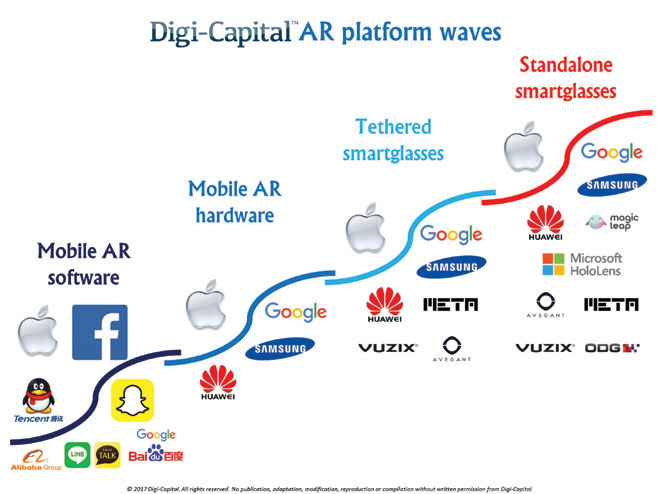
The idea that the technology will be available on multiple devices just shows how deeply committed Apple is to AR. With the development community now having access to a number of creation tools, platforms, and services to engage these digital titans, there will be few industry sectors that are not affected. Some of these include education, real estate, shopping, gaming, tourism, health, and film and television.
2018 potentially realizes this massive wave of new future realities, let’s get moving.
